R.P.A. – Rationalist Press Association
—
THE RATIONALIST PRESS ASSOCIATION – R.P.A.
—
—
The Rationalist Press Association – R.P.A. is an organisation founded, at the end of the 19th century, out of Britain’s humanist, secularist, rationalist, and freethought movements, following the radical activism of Thomas Paine (1737-1809), William Godwin (1756-1836), Mary Wollstonecraft (1759-1797), Richard Carlile (1790-1843), Charles Bradlaugh (1833-1891), Charles Watts (1836-1906), George Jacob Holyoake (1817-1906), and others.
—
 |
—
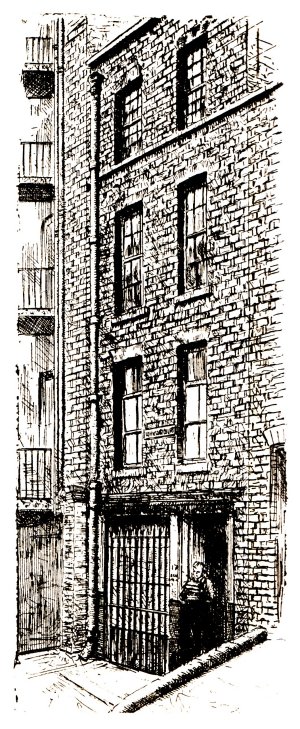
— It has been organised by a first group of militants – George Jacob Holyoake (1817-1906), Frederick James Gould (1855-1938), Joseph McCabe (1867-1955), Hypatia Bradlaugh Bonner (1858-1935), &c. – gathered around the publisher Charles Albert Watts (1858-1946) and his printworks (CA Watts & Company Limited at Johnson’s Court, just off Fleet street, London). — — first siege of RPA, at Johnson’s Court, 17. |
— expanded headquarters of RPA, at Johnson’s Court
|
 |
—

—
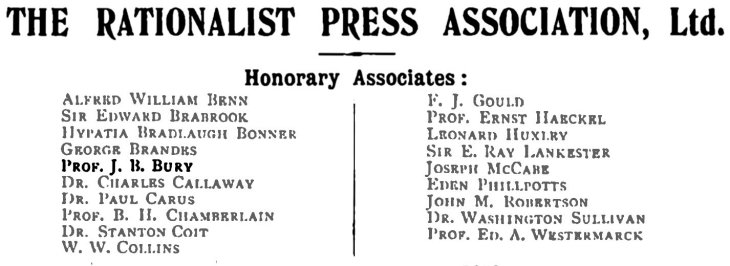
— |
—
|
—
ARTICLES OF J.B. BURY IN

—
| John B. BURY – THE SUCCESS OF CHRISTIANITY – in The R.P.A. Annual and Ethical Review, 1915, pp.3-7 |
| John B. BURY – CLEOPATRA NOSE – in The R.P.A. Annual and Ethical Review, 1916, pp.16-23 |
| John B. BURY – THE INFLUENCE OF CHRISTIANITY ON ROMAN CRIMINAL LAW – in The R.P.A. Annual and Ethical Review, 1918, pp.19-24 |
| John B. BURY – FREEDOM OF SPEECH AND CENSORSHIP – in The R.P.A. Annual and Ethical Review, 1919, pp.16-19 |
| John B. BURY – PLAYING FOR SAFETY – in The R.P.A. Annual, 1920, pp.13-19 |
| John B. BURY – THEISM – in: The R.P.A. Annual, 1921, pp.16-18 |
| John B. BURY – BAYLE ON ORIGINAL SIN – in The R.P.A. Annual, 1923, pp.29-32 |
| John B. BURY – THE TRIAL OF SOCRATES – in The R.P.A. Annual, 1926, pp.17-26 |
—
—
ARTICLES OF J.B. BURY IN
—

—
| John B. BURY – Mr. BELLOC ON ANTI-CATHOLIC HISTORY – in The Literary Guide, 1915, January, p.8; February, pp.25-26; March, pp.41-43. ⊕ |
—

—
Progress then is a theory which involves a synthesis of the past and a prophecy of the future. It is based on an interpretation of history which regards men as slowly advancing – pedetemtim progredientes – in a definite and desirable direction, and infers that this progress will continue indefinitely”.
—
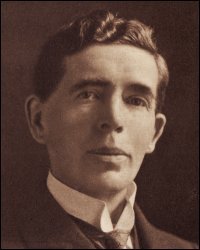
John B. Bury (1861-1927)